
Cotton County Court Records After a Jail Arrest
Court records after a jail arrest in Cotton County should be read as a chain of events, not as one single file. A person may first be arrested by the Cotton County Sheriff's Office, Walters Police Department, Oklahoma Highway Patrol, or another agency. If detention continues, the person is booked at the Cotton County Jail / Cotton County Detention Center. That booking can create a jail register entry, bond note, warrant hold, and arrest basis. It does not always create the final court charge.
The court record starts to matter most after District 5 District Attorney review. Kyle Cabelka is listed as the District 5 District Attorney for Comanche and Cotton counties. The DA reviews the report, evidence, prior record, witness or victim information, and legal elements. When prosecution is supported, the DA files charges in Cotton County District Court. The court docket then becomes the main record for formal charges, hearings, judge assignments, bond orders, warrants, dispositions, payments, and case status.
The custody side and the case side should stay separate. Current jail custody and booking details belong with Cotton County jail inmate records. Booking photos, if kept and releasable, belong with Cotton County jail mugshots. Court records after an arrest answer a different question: what did the prosecutor file, what has the court done, and what legal status does the case now show?
Cotton County Arrest to Court Record
The arrest to court pathway is usually: arrest, booking, prosecutor review, filed criminal case, court hearings, and final disposition. In Cotton County, that pathway runs through a courthouse-centered records system. The state county-officer roster names Sheriff Tim King, and the sheriff and jail, Court Clerk, County Clerk, and DA contact points all tie back to 301 N. Broadway in Walters. That local structure matters because a missing online jail roster does not mean no record exists. It means the current custody record may require a phone call or written request while filed criminal cases are checked in Oklahoma court portals.
- Confirm the arrest or booking with the Cotton County Sheriff's Office if current custody is the first concern.
- Allow for DA review. Jail booking charges can change before a formal charge is filed.
- Search OSCN docket search by Cotton County District Court, defendant name, or case number.
- Search ODCR as a second Oklahoma court-record portal for participating courts.
- Contact the Cotton County Court Clerk for older, missing, certified, or office-only court records.
First appearance and arraignment language can vary in public use, but the plain point is the same: a charged person first goes before a judge, learns the charge or charge basis, and may have bond addressed. The court docket is the place to watch for those events after a Cotton County jail arrest.
District 5 DA Court Filing Role
The Oklahoma District Attorneys Council District 5 page names Kyle Cabelka as the District Attorney for Cotton County and Comanche County. The Cotton County DA office is listed at Cotton County Courthouse, 301 N. Broadway, Walters, OK 73572, phone (580) 875-6111, fax (580) 875-2452. That office is the prosecution contact for filed Cotton County criminal cases, victim service routing, and payment links noted by the DA page for Cotton County programs such as bogus check, diversion, restitution, or supervision payments.
The DA does not run the jail roster. The DA also does not make an arrest by itself. Its role comes after the arrest report reaches prosecution review. A booking charge may be broad, incomplete, or based on the arresting officer's initial view. A filed charge is the DA's formal accusation in court. That distinction is the core reason to search Cotton County court records after a jail arrest instead of relying only on jail booking language.
The DA page also links users toward OSCN for case tracking, OSBI CHIRP for criminal-history checks, ODOC Offender Lookup for sentenced state custody, and VINELink for victim notification. Each of those systems answers a different question. Court records show case events. Criminal-history checks are broader state background products. ODOC shows sentenced state prisoners. VINELink supports custody notification.
Search Cotton County Court Records on OSCN
OSCN is the Oklahoma State Courts Network, and its docket search supports Cotton County District Court. A useful search starts with the county or court dropdown, then adds a case number or defendant name. When the arrest date is known, filing-date ranges can reduce false matches. The example case-number pattern noted in the research is CF-2014-1, with criminal case types such as CF for felony, CM for misdemeanor, TR for traffic, WL for wildlife, SW for search warrant, and CP for criminal property.
The OSCN docket search form captured for the project shows the search controls used for Cotton County District Court and statewide Oklahoma court searches.
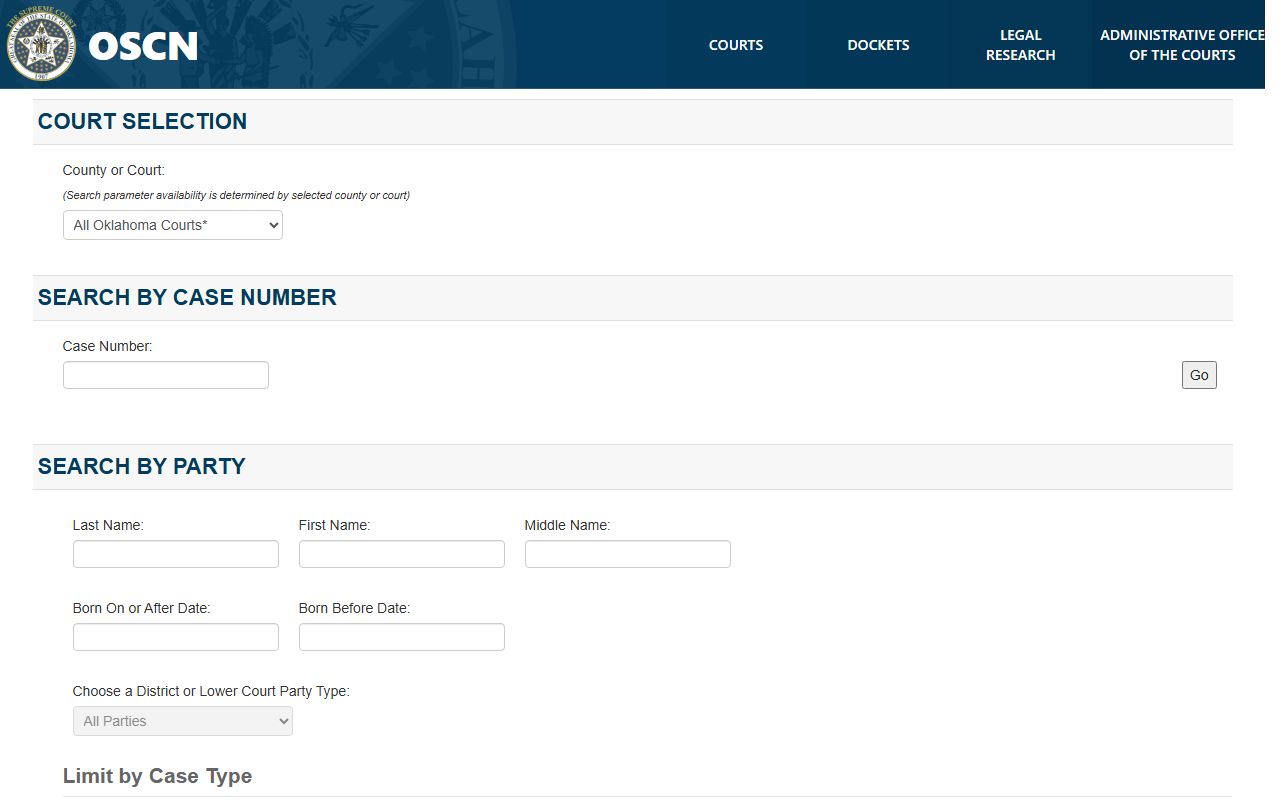
That form is best for narrowing a Cotton County court records search after arrest by name, case type, date range, party role, or citation number when those details are known.
| OSCN Field | Type | Required | Cotton County Use |
|---|---|---|---|
| County or Court | Dropdown | Yes to localize | Select Cotton County District Court. |
| Case Number | Text | No | Use a known number such as CF-2014-1. |
| Last, First, Middle Name | Text | No | Search the defendant's legal name and try spelling variants. |
| Born On or After / Before | Date text | No | Narrows common names by birth-date range. |
| Party Type | Dropdown | No | Use Defendant for criminal cases, or All Parties for a broad search. |
| Limit by Case Type | Dropdown | No | Use Criminal Felony, Criminal Misdemeanor, Traffic, Wildlife, Search Warrant, or Criminal Probable Cause as needed. |
| Filed / Closed Date Ranges | Date text | No | Helpful when the arrest date or filing window is known. |
| Traffic Citation Number | Text | No | District court citations only, not municipal citations. |
Search Cotton County Court Records on ODCR
ODCR is another public Oklahoma court-record portal. The captured search page includes a court group field, a court dropdown with Cotton, party-name search, party-type controls, case-type filters, and a full case-number control. ODCR is JavaScript-driven, so fields may display or change based on the search mode selected. For Cotton County court records after a jail arrest, ODCR is most useful as a second check when OSCN has too many matches, a case number is partly known, or the user wants to compare docket entries across portals.
The ODCR search page screenshot used for the project shows Cotton County in a statewide court-search context.
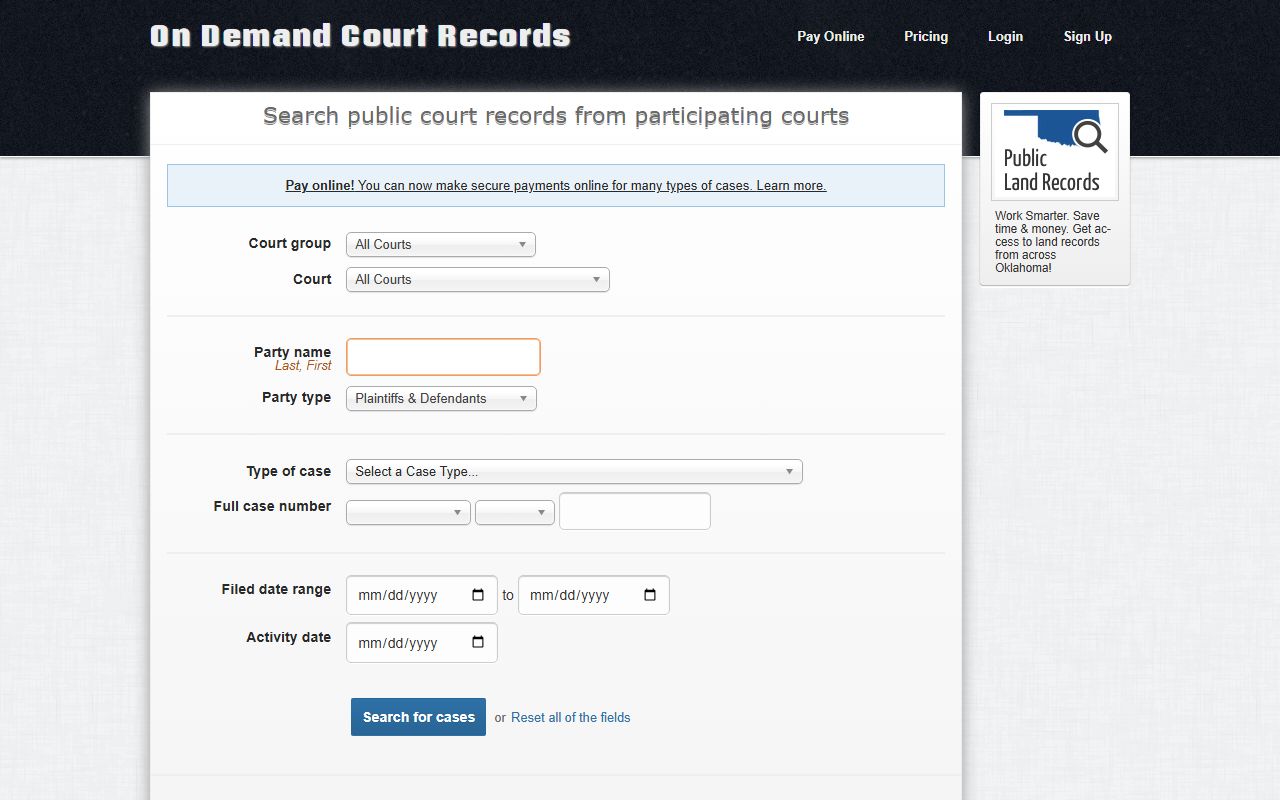
Because ODCR interaction depends on the browser interface, treat the visible fields as search aids and verify case meaning from the docket and the Court Clerk when a certified record is needed.
| ODCR Field | Type | Required | Cotton County Use |
|---|---|---|---|
| Court group | Dropdown | No | Use All Courts or Oklahoma District Courts. |
| Court | Dropdown | No | Select Cotton when limiting results to Cotton County. |
| Party name | Text | No | Use the shown Last, First style when possible. |
| Party type | Dropdown | No | Use plaintiffs and defendants or all parties depending on search breadth. |
| Type of case | Dropdown | No | Includes criminal felony, criminal misdemeanor, criminal probable cause, traffic, wildlife, and search warrant options. |
| Full case number | Segmented control | No | Use when the prefix and number are already known. |
Cotton County Charging Documents
Formal court records after an arrest are built from charging documents. Oklahoma criminal procedure recognizes prosecution by formal charging instruments, and the research flags the complaint, information, and indictment distinction as important. A charging document is not a conviction. It is the written accusation that starts or frames the criminal case and tells the court what the state claims happened.
| Document | Who Uses It | What It Does | How to Read It |
|---|---|---|---|
| Complaint | Law enforcement or prosecutor, depending on the matter | States the alleged offense or probable-cause basis that can begin court action. | Compare it with later filed or amended charges. |
| Information | District Attorney | Formally charges a defendant in many Oklahoma criminal cases. | Treat it as the prosecutor's filed charge, not proof of guilt. |
| Indictment | Grand jury process | Charges an offense after grand-jury action. | Less common for routine jail-arrest searches, but still a formal charging instrument. |
A Cotton County docket may also show probable-cause entries, search-warrant matters, amended informations, dismissals, or bond orders. Read the newest docket entry, not just the first line returned by a search portal.
Cotton County Charge Status
Charge status can change several times after a Cotton County jail arrest. A jail booking may list one arrest basis. The DA may file a different charge. Later, a count may be amended, reduced, dismissed, deferred, or resolved by plea or trial. Case status should be read from the court docket and, when needed, confirmed with the Cotton County Court Clerk or a lawyer.
| Status | Meaning in Court Records | Practical Reading Tip |
|---|---|---|
| Pending | The charge is active and has not reached final disposition. | Check the next hearing, bond, and warrant entries. |
| Filed | The DA has placed a formal charge before Cotton County District Court. | Compare filed charges with the original jail booking reason. |
| Amended or reduced | The filed count changed after review, negotiation, or court action. | Use the latest version when describing current case status. |
| Dismissed | The count or case was not pursued or was dismissed by court or prosecutor. | A dismissal is not the same as an automatic expungement. |
| Deferred or suspended sentence | Oklahoma outcomes can include conditions or delayed final judgment effects. | Read the docket carefully and verify legal effect before relying on it. |
| Conviction | A guilty plea, verdict, or court finding resolved the charge as guilt. | Look for disposition and sentence entries, not just charge captions. |
Bond After Cotton County Arrest
Bond can be set by a judge or magistrate, by a schedule, or by a court order at or after the first court step. The Oklahoma Insurance Department regulates bail bondsmen, which means surety bond is a lawful Oklahoma release path when the court permits it. Cotton County-specific bond payment instructions, card fees, kiosk rules, and after-hours procedures were not located in official jail pages, so exact payment details should be verified with the jail, Court Clerk, or licensed bondsman before money changes hands.
| Bond Type | How It Works | Cotton County Checkpoint |
|---|---|---|
| Cash bond | Cash is posted as ordered by the court or jail process. | Confirm payee, amount, refund process, and where payment is accepted. |
| Surety bond | A licensed bondsman posts bond under a contract. | Verify licensing through Oklahoma bail-bond regulation and confirm the court allows surety. |
| Personal recognizance | The defendant signs a promise to appear, often with conditions. | Availability depends on charge, judge, history, and law. |
| Property bond | Real property may secure release in some matters. | Confirm with the Court Clerk or judge before assuming it is allowed. |
| No-bond or hold | Release is blocked by order or by another agency hold. | Ask about warrants, parole or probation holds, DOC holds, federal holds, ICE detainers, and other-county holds. |
Paying one bond does not always mean release. A separate warrant, detainer, or hold can keep a person in custody after the first Cotton County charge is addressed.
Warrants in Cotton County Court Records
No official Cotton County sheriff active-warrant web search was located. Warrant checks therefore rely on a mix of sheriff phone or counter contact, OSCN and ODCR docket entries, and Court Clerk help with case numbers. Bench warrants and failure-to-appear warrants often appear in the underlying criminal or traffic case. Search warrants may appear under SW case types. Municipal Walters warrants or tickets may not appear in district court, so Walters Police or the municipal court channel may be needed for city matters.
A warrant can become a jail booking when an officer confirms it, arrests the person, and transports the person for booking. Bond may already be set in the warrant, may be set by schedule, or may require a court appearance. Some warrant information may be limited by phone. For arrest-risk questions, safer steps include contacting an attorney, the Court Clerk, or the sheriff to learn whether bond is set and whether a hearing or surrender is required.
Note: Cotton County Sheriff's Office has an OSBI ODIS service-level agreement for criminal-justice access, but that system is not a public warrant search.
Cotton County Court Record Comparisons
Two comparisons matter more than almost any other point in Cotton County court records after arrest: charge versus conviction, and sealed versus expunged. A charge is an accusation. A conviction is an outcome. A sealed record is restricted from ordinary public access. Expungement is a legal process tied to eligibility and court orders, not a casual website removal request.
| Question | First Term | Second Term | Why It Matters |
|---|---|---|---|
| Charge vs conviction | A charge is what the jail or DA alleges. | A conviction follows a guilty plea, verdict, or court finding. | An arrest or filed charge is not proof that the person was found guilty. |
| Filed charge vs booking charge | The filed charge is the DA's court accusation. | The booking charge is the jail intake reason. | The filed charge can be narrower, broader, or different from booking language. |
| Sealed vs expunged | Sealed records are restricted from public view by legal authority. | Expunged records are handled under Oklahoma expungement law and court orders. | Dismissal alone does not guarantee removal from every public or agency record. |
Older Cotton County Court Records
If OSCN or ODCR does not show a Cotton County case, the next step is the Cotton County Court Clerk. The county-services page lists Court Clerk Terry Kelley at 301 N. Broadway, Walters, OK 73572, phone (580) 875-3029, fax (580) 875-2288. Older files, certified copies, clerk-only documents, and records with indexing gaps may require office contact. Copy and certification fees may apply, but the research did not locate a Cotton County-specific fee schedule for this page.
Older or missing court records should not be confused with a clean criminal history. A case may be absent from a public portal because of age, indexing, a spelling issue, limited portal coverage, sealing, expungement, or because no District Court case was filed. A sheriff booking record, police report, municipal matter, state criminal-history record, or agency-only entry can exist outside the public district court portal.
Criminal History Limits After Arrest
Cotton County court records are case records, not a full background report. A person may have cases in other Oklahoma counties, municipal court entries, sealed matters, expunged matters, federal cases, or state criminal-history entries that do not appear in a simple Cotton County District Court search. The DA page points to OSBI CHIRP for criminal-history checks, while the research also notes ODOC for sentenced state custody, BOP for federal inmates, ICE for immigration custody, and VINELink for notification.
Public records also have limits. Oklahoma Open Records Act material supports access to many jail-register and law-enforcement records if kept, including arrestee descriptions, facts concerning arrest, and jail booking information. Agencies may still redact or withhold confidential, juvenile, sealed, medical, security-sensitive, or active-investigation material. Court records after a jail arrest should be verified with the originating court or agency before use in any serious legal, housing, employment, or licensing decision.
Important: Cotton County court lookups are public-record research tools and are not consumer reports for FCRA-regulated decisions.